How Much Does MD Cost in India 2026?
Choosing a postgraduate medical specialization is one of the biggest decisions after completing MBBS. Along with selecting the right branch, understanding how much MD costs in India is equally important because tuition fees vary significantly depending on the type of medical college and admission category.
The cost of pursuing an MD course can range from less than ₹5 lakh in government medical colleges to more than ₹3 crore under the NRI quota in some deemed universities. The final fee depends on several factors such as:
- Government or private medical college
- State fee regulations
- Medical specialization
- Management quota or NRI quota
- College reputation
- Hospital infrastructure
- Clinical exposure
Candidates with higher NEET PG ranks generally secure government colleges where fees are comparatively low, while students opting for private, management, or NRI quota seats should carefully evaluate the total course cost before taking admission.
In this guide, you’ll learn:
- How much MD costs in India
- Government vs private MD fees
- Management quota MD fees
- NRI quota fee structure
- Branch-wise MD course fees
- Admission process and eligibility
- Tips to choose an affordable MD college
What Determines MD Fees in India?
There is no fixed fee structure for MD admission across India. Every medical college follows the fee regulations approved by the respective authority, which is why the total cost differs from one institution to another.
The major factors affecting MD fees include:
- Type of Medical College: Government medical colleges charge the lowest tuition fees because they receive financial support from the government. Private and deemed universities generally have higher tuition fees, especially for high-demand specialties.
- Medical Specialization: Popular branches such as MD Dermatology, MD Radiology, and MD General Medicine usually have higher tuition fees than specialties with comparatively lower demand.
- Admission Category: The admission category has a significant impact on the overall cost. Government quota seats are the most affordable, while management quota and NRI quota seats carry substantially higher tuition fees.
- State Fee Regulations: Each state has its own fee committee and counselling authority that determines the approved fee structure for private medical colleges.
- College Reputation: Medical colleges with strong academic records, experienced faculty, better hospital infrastructure, and higher patient inflow generally charge higher tuition fees.
MD Fees in Government Medical Colleges
Government medical colleges remain the most affordable option for postgraduate medical education in India. Candidates with excellent NEET PG ranks usually secure admission through government quota seats, where tuition fees are considerably lower than in private institutions.
Average Government MD Fees
| Category | Approximate Fees |
|---|---|
| Annual Tuition Fees | ₹20,000 – ₹2,00,000 |
| Total Course Fees | ₹1 lakh – ₹6 lakh |
Government colleges also provide:
- Excellent clinical exposure
- High patient load
- Experienced faculty
- Better return on investment
- Lower educational debt
Although fees are low, competition is extremely high because the number of seats is limited and thousands of candidates compete through NEET PG counselling every year.
MD Fees in Private Medical Colleges
Private medical colleges provide another pathway for candidates who qualify NEET PG but are unable to secure a government seat. Tuition fees vary depending on the institution, specialization, and state fee regulations.
Average Private MD Fees
| Category | Approximate Fees |
|---|---|
| Annual Tuition Fees | ₹10 lakh – ₹45 lakh |
| Total Course Cost | ₹30 lakh – ₹1.35 crore |
Popular specialties such as Dermatology, Radiology, and General Medicine generally have higher tuition fees because of greater demand.
Many private colleges also charge separately for:
- Hostel accommodation
- Mess facilities
- Examination fees
- Security deposit
- University charges
- Miscellaneous institutional expenses
Candidates should compare the complete fee structure rather than focusing only on annual tuition before choosing a medical college.
MD Management Quota Fees in India
For candidates who qualify NEET PG but are unable to secure a government seat, Management Quota offers another opportunity to pursue an MD degree in reputed private medical colleges and deemed universities.
Admission through the Management Quota is conducted only through the official counselling authorities such as MCC or the respective state counselling bodies. There is no direct admission without NEET qualification.
Management quota fees vary considerably depending on the medical specialty, college reputation, infrastructure, and state fee regulations.
Average MD Management Quota Fees in India
| MD Specialization | Approximate Annual Fees |
|---|---|
| MD General Medicine | ₹18–35 Lakhs |
| MD Pediatrics | ₹18–30 Lakhs |
| MD Anesthesiology | ₹12–22 Lakhs |
| MD Dermatology | ₹35–80+ Lakhs |
| MD Radiology | ₹45 Lakhs–₹1 Crore+ |
The total course cost generally ranges between ₹40 lakh and ₹2 crore for the complete three-year MD program.
Before taking admission, candidates should verify:
- Official fee notification
- Tuition fees
- Hostel charges
- Examination fees
- Refund policy
- Bond rules (if applicable)
- Counselling authority
MD NRI Quota Fees in India
Many deemed universities and selected private medical colleges reserve seats under the NRI Quota for eligible NRI, OCI, Foreign National, and NRI-sponsored candidates.
Compared with government and management quota seats, the tuition fee under the NRI category is considerably higher and is usually charged in US Dollars.
Average MD NRI Quota Fees
| Category | Approximate Fees |
|---|---|
| Annual Fees | USD 40,000–1,20,000 |
| Total Course Cost | ₹1.2 Crore–₹3.5 Crore+ |
The exact fee depends on:
- College
- Branch
- State
- NRI regulations
- Infrastructure
- Seat demand
MD Fees by Popular Specializations
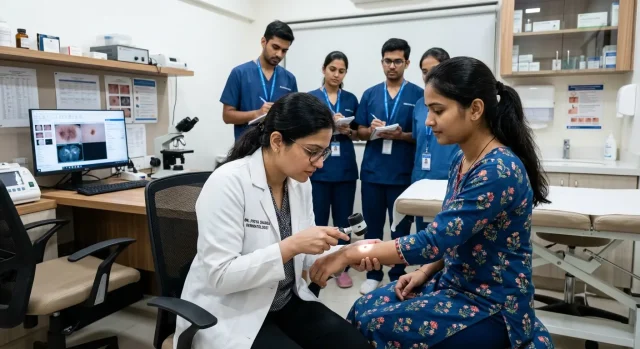
Not every MD specialization has the same tuition fee. High-demand branches usually cost significantly more.
MD Dermatology
One of India’s most competitive postgraduate branches.
Approximate Cost:
- Government Colleges: ₹1–6 Lakhs
- Private Colleges: ₹40 Lakhs–₹1.5 Crore
- NRI Quota: ₹2–3 Crore+
MD Radiology
Radiology is among the highest-priced MD specializations because of excellent career prospects.
Approximate Cost:
- Government Colleges: ₹2–8 Lakhs
- Private Colleges: ₹50 Lakhs–₹2 Crore
- NRI Quota: ₹2.5–3.5 Crore
MD General Medicine
One of the most preferred clinical specialties.
Approximate Cost:
- Government Colleges: ₹1–5 Lakhs
- Private Colleges: ₹30–90 Lakhs
- NRI Quota: ₹1–2 Crore
MD Pediatrics
Demand for Pediatrics remains consistently high.
Approximate Cost:
- Government Colleges: ₹1–4 Lakhs
- Private Colleges: ₹25–70 Lakhs
- NRI Quota: ₹1–2 Crore
MD Anesthesiology
Compared with Dermatology and Radiology, Anesthesiology generally has a lower fee structure.
Approximate Cost:
- Government Colleges: ₹1–3 Lakhs
- Private Colleges: ₹15–40 Lakhs
- NRI Quota: ₹80 Lakhs–₹1.5 Crore
Government vs Private vs Management vs NRI Quota Fees
| Admission Category | Approximate Total Cost |
|---|---|
| Government Colleges | ₹2–6 Lakhs |
| Private Colleges | ₹30 Lakhs–₹1.2 Crore |
| Management Quota | ₹40 Lakhs–₹2 Crore |
| NRI Quota | ₹1.2–₹3.5 Crore+ |
This comparison helps candidates estimate the financial commitment before participating in NEET PG counselling.
Additional Expenses During MD
Apart from tuition fees, students should also budget for several additional expenses throughout the MD course.
These commonly include:
- Hostel accommodation
- Mess charges
- Examination fees
- Security deposit
- Library fees
- University registration fees
- Clinical materials
- Books and study resources
- Personal expenses
Depending on the medical college, these additional expenses may add ₹3 lakh to ₹15 lakh over the entire course duration.
NEET PG Requirement for MD Admission
Qualifying NEET PG is mandatory for admission to every MD seat in India.
Whether you are applying for:
- Government quota
- Private quota
- Management quota
- NRI quota
- Deemed university
NEET PG qualification is compulsory.
Admission is conducted only through the prescribed counselling authorities, and candidates must satisfy the eligibility criteria applicable to their chosen college and admission category.
MD Admission Process in India
Admission to the MD course follows a structured counselling process after NEET PG results are declared.
Step 1: Qualify NEET PG
Secure the minimum qualifying percentile prescribed for your category.
Step 2: Register for Counselling
Complete registration with:
- MCC Counselling
- State Counselling Authority
depending on the type of medical college.
Step 3: Document Verification
Upload and verify all required academic and identity documents.
Step 4: Choice Filling
Select preferred colleges and MD specializations based on your NEET PG rank and budget.
Step 5: Seat Allotment
Seats are allotted according to merit, category, preferences, and availability.
Step 6: Admission Confirmation
Report to the allotted college, pay the prescribed fees, and complete the admission formalities within the specified deadline.
Tips to Reduce the Cost of MD
If you’re planning to pursue an MD in India while managing your budget, consider these practical tips:
- Aim for a higher NEET PG rank to increase your chances of securing a government seat.
- Participate in both MCC and state counselling to explore more admission opportunities.
- Compare the complete fee structure of multiple colleges before making a decision.
- Don’t overlook additional expenses such as hostel, examination, and security charges.
- Research previous years’ fee trends and cutoff patterns to shortlist colleges realistically.
- Consider colleges with strong clinical exposure and good academic outcomes instead of focusing only on brand value.
- Keep all required documents ready to avoid missing counselling deadlines.
These steps can help you choose an MD college that balances affordability with quality education.
Top Medical Colleges for MD in India
Choosing the right medical college is as important as choosing the right MD specialization. Government institutions usually offer lower tuition fees, while private and deemed universities provide additional seat options through management and NRI quotas.
Some of the most preferred colleges for MD admission in India include:
| College | Type | Approximate MD Fees |
|---|---|---|
| AIIMS New Delhi | Government | ₹5,000–₹15,000/year |
| PGIMER Chandigarh | Government | ₹10,000–₹25,000/year |
| JIPMER Puducherry | Government | ₹20,000–₹40,000/year |
| CMC Vellore | Private | Moderate (varies by branch) |
| Kasturba Medical College (Manipal) | Deemed | Higher fee structure |
| JSS Medical College | Deemed | Branch-wise fees apply |
| DY Patil Medical College | Deemed | Management & NRI seats available |
| Bharati Vidyapeeth Medical College | Deemed | Management & NRI quota available |
Note: Always verify the latest fee notification issued by the respective college or counselling authority before participating in counselling, as fee structures may change every academic year.
Factors That Affect MD Course Cost in India
Many students ask why the cost of an MD course varies so much from one college to another. The answer depends on several important factors.
The total MD course fee is influenced by:
- Type of medical college (Government, Private, or Deemed University)
- MD specialization selected
- Admission category (Government, Management, or NRI Quota)
- State fee regulations
- College reputation and demand
- Hospital infrastructure and patient inflow
- Availability of seats
- Counselling authority
- Hostel and living expenses
Highly competitive branches such as Dermatology, Radiology, and General Medicine generally have significantly higher fees due to strong demand and limited seat availability.
Is MD Worth the Cost?
Pursuing an MD requires a significant financial investment, especially in private or deemed medical colleges. However, the long-term value depends on the specialization you choose, the quality of clinical training, and your future career goals.
An MD degree can provide:
- Better career opportunities
- Higher earning potential
- Opportunities for super specialization (DM/MCh)
- Academic and teaching careers
- Private practice
- Hospital consultant positions
- Research opportunities
Instead of choosing a college solely based on fees, compare:
- Clinical exposure
- Faculty
- Hospital infrastructure
- Academic reputation
- Patient load
- Internship and residency experience
- Placement and career opportunities
A well-informed decision can provide better long-term returns than simply selecting the lowest-cost option.
Frequently Asked Questions
Conclusion
Choosing the right postgraduate medical course requires balancing your NEET PG rank, budget, preferred specialization, and career goals. While the cost of MD Dermatology seats in India is among the highest due to strong demand, the overall MD cost in India varies widely based on the type of medical college and admission category.
Government colleges remain the most affordable option, whereas private, deemed, management quota, and NRI quota seats provide additional opportunities for candidates who may not secure a government seat. Before finalizing your admission, compare tuition fees, clinical exposure, hospital infrastructure, faculty, previous years’ cutoff trends, and the total cost of the course rather than focusing only on the annual fee.
With careful planning and informed counselling choices, you can pursue an MD specialization that aligns with both your budget and long-term medical career aspirations.
Also Check: How Can I Get Admission in NRI Quota for MBBS 2026?
Disclaimer: The information provided in this blog is for informational purposes only. While we strive to keep the content accurate and up to date, we make no warranties of any kind about the completeness, accuracy, reliability, or availability of the information. Admission criteria, fees structures, and other details are subject to change as per the respective institutions’ policies. We recommend verifying the details directly from official sources.</p
