NRI quota MBBS seats in India have seen a sharp rise in demand, with over 15% seats reserved in private and deemed medical colleges. Every year, thousands of students explore NRI quota options to secure MBBS admission with lower NEET ranks but higher financial investment.
However, most students are confused about:
- Is NRI quota available in government medical colleges?
- What is the fees for NRI quota in medical colleges?
- How many NRI MBBS seats are available in India?
👉 The reality is — fees, seat availability, and eligibility vary drastically between government, private, and deemed universities.
This detailed guide covers:
- NRI quota MBBS fees in India (2026 updated)
- Government vs private college comparison
- Total NRI MBBS seats in India
- Eligibility, documents & admission process
Overview of NRI Quota in MBBS
NRI quota is a reserved category for Non-Resident Indians (NRIs), OCI, PIO, or NRI-sponsored students in medical colleges across India.
✔ Available in:
- Private medical colleges
- Deemed universities
- Some government colleges (limited cases)
✔ Seat Reservation:
- Up to 15% seats reserved under NRI quota
✔ Admission Rule:
- NEET is mandatory (no direct admission without NEET)
Is NRI Quota Available in Government Medical Colleges?
Yes, NRI quota is available in selected government medical colleges in India, but it is not offered by every government medical college or every state. A few states reserve a limited percentage of MBBS seats under the NRI category according to their respective admission policies.
Candidates seeking admission through the NRI quota must qualify NEET UG, fulfill the prescribed NRI eligibility criteria, submit valid NRI documents, and participate in the relevant counselling process.
Students should remember that NRI quota admissions remain merit-based. Having NRI status alone does not guarantee an MBBS seat. Admission depends on the NEET score, counselling participation, document verification, seat availability, and the rules applicable in the concerned state.
Reality Check:
- Only select states offer NRI quota in government medical colleges
- Not all government colleges provide NRI seats
- Seats are extremely limited (1–5 seats per college)
States Offering NRI Quota in Government Colleges:
- Punjab
- Rajasthan
- Himachal Pradesh
- Haryana
States with No NRI Quota in Govt Colleges:
- Tamil Nadu
- Karnataka (mostly private only)
- Maharashtra
👉 Conclusion: Majority NRI MBBS seats are in private & deemed universities
👉 Many students specifically ask: is NRI quota available in government medical colleges in India? The answer is yes, but availability is extremely limited. Compared to private institutions, the number of seats under NRI quota in government medical colleges is very low, making competition relatively higher.
Why Do Only Some Government Medical Colleges Offer NRI Quota?
Many students assume every government medical college has NRI quota seats, but this is not the case. The availability of NRI quota seats depends on the policies of the respective state government and the counselling authority.
While some states reserve a limited number of seats for eligible NRI candidates, many government medical colleges do not offer this category at all.
Before applying, candidates should always verify the latest seat matrix and counselling notification issued by the concerned authority for the admission year.
How Are NRI Quota Seats Allotted in Government Medical Colleges?
Admission to NRI quota seats in government medical colleges is generally conducted through the respective counselling authority. Candidates must qualify NEET UG, complete the registration process, submit valid NRI documents, and participate in counselling.
Seat allotment depends on eligibility, merit, seat availability, and the applicable admission rules.
What is the Fees for NRI Quota in Medical Colleges?
NRI quota MBBS fees vary depending on the type of college.
Private / Deemed Colleges (NRI Quota Fees)
- Tuition Fees: ₹25 – ₹60 Lakhs per year
- Total Course Cost: ₹1.5 – ₹3 Crore
- Hostel + Misc: ₹2 – ₹5 Lakhs/year
👉 High-demand colleges (Manipal, DY Patil, etc.) → Highest fees
Fees for NRI Quota in Government Medical Colleges
- Tuition Fees: ₹15 – ₹40 Lakhs per year
- Total Cost: ₹80 Lakhs – ₹1.5 Crore
👉 Lower than private colleges but:
- Seats are limited
- Competition is high
Note: When students search what is the fees for NRI quota in medical colleges, they must understand that fees vary significantly depending on the type of institution. Private colleges generally have higher NRI quota fees, while fees for NRI quota in government medical colleges are comparatively lower but still higher than regular seats.
Factors Affecting NRI Quota Fees in Government Medical Colleges
The fees for NRI quota in government medical colleges are generally lower than those charged by many private or deemed universities, but they are still significantly higher than the regular government quota fees. The fee structure may vary depending on:
- State government policies
- Medical college
- Tuition fee regulations
- NRI category guidelines
- Other institutional charges
Candidates should always verify the latest approved fee structure before participating in counselling.
Which Government Medical Colleges Offer NRI Quota?
Many students believe that every government medical college has NRI quota seats, but this is not correct.
Only selected states reserve NRI quota seats in their government medical colleges, and the number of seats varies according to state policy.
Examples of States Offering NRI Quota in Government Medical Colleges
| State | NRI Quota Availability |
|---|---|
| Rajasthan | Available in selected government colleges |
| Punjab | Available |
| Haryana | Available |
| Himachal Pradesh | Available |
| Jammu & Kashmir | Available in accordance with applicable rules |
| Other States | Depends on yearly counselling policy |
Candidates should always verify the latest counselling brochure because seat availability and NRI policies may change from year to year.
How Many NRI MBBS Seats in India?
Understanding total NRI MBBS seats is crucial.
Estimated Data (2026)
- Total MBBS Seats in India: ~1,10,000
- Private/Deemed Seats: ~55,000
- NRI Quota Seats (~15%):
👉 Approx NRI MBBS Seats in India: 7,000 – 8,500
Distribution:
| Type | Seats |
|---|---|
| Private Colleges | 80% |
| Deemed Universities | 15% |
| Government Colleges | 5% |
Are NRI MBBS Seats Increasing Every Year?
The total number of NRI MBBS seats in India may change from one admission session to another based on approvals granted by the competent authorities, changes in seat matrices, and state-specific admission policies.
While private and deemed universities account for the majority of NRI seats, some government medical colleges also reserve a limited number of seats under the NRI category. Candidates should always refer to the latest counselling notifications for updated seat availability.
Eligibility for NRI Quota MBBS Admission
To apply under NRI quota in medical colleges:
Basic Eligibility
- 10+2 with PCB
- Minimum 50% marks
- NEET qualified
NRI Criteria
- NRI / OCI / PIO / Sponsored candidate
- Valid passport required
Documents Required for NRI Quota
Mandatory Documents:
- NEET Scorecard
- 10th & 12th marksheets
- Passport of student/sponsor
- Visa copy
- Relationship proof
- Sponsorship affidavit
- Embassy certificate
👉 Missing documents = Admission rejection risk
MBBS Admission Process Under NRI Quota
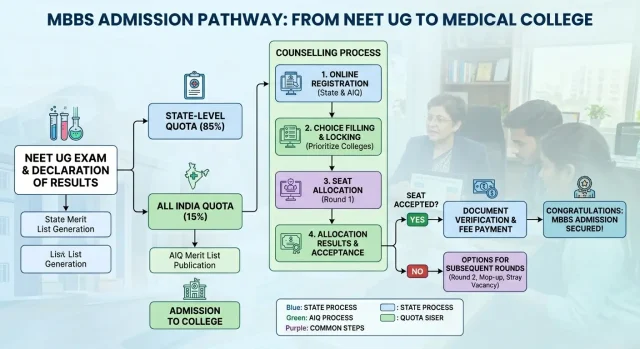
Step-by-Step Process:
1️⃣ NEET Qualification
Must clear NEET exam
2️⃣ Registration
Apply through:
- MCC (Deemed universities)
- State counselling
3️⃣ Choice Filling
Select colleges under NRI quota
4️⃣ Seat Allotment
Based on:
- NEET score
- Category
- Availability
5️⃣ Admission Confirmation
- Pay fees
- Document verification
State-Wise NRI Quota Insights
🔹 Karnataka
- Maximum NRI seats
- High fees
🔹 Maharashtra
- Premium colleges
- Higher competition
🔹 Madhya Pradesh
- Moderate fees
- Good seat availability
🔹 Punjab
- Government NRI seats available
NRI Quota in MP Medical Colleges 2026
Many students also search for NRI quota in MP medical colleges because Madhya Pradesh has several government and private medical colleges that offer MBBS admission under the NRI category, subject to the admission rules notified for the respective academic session.
Candidates seeking admission should first qualify NEET UG and participate in the counselling process conducted by the competent authority.
The availability of NRI quota seats, eligibility criteria, and fee structure may vary depending on the medical college and the applicable state regulations.
Before applying, students should verify the latest counselling brochure, approved seat matrix, and official fee notification to confirm whether their preferred medical college offers NRI quota seats for the current admission year.
Government vs Private NRI Quota (Comparison)
| Factor | Government | Private |
|---|---|---|
| Fees | Lower | High |
| Seats | Very limited | High |
| Cutoff | Higher | Lower |
| Availability | Limited states | All India |
Can Indian Students Apply Under NRI Quota?
Yes. Eligible Indian students may apply under the NRI quota if they are sponsored by an eligible NRI relative and fulfill the prescribed eligibility conditions.
Candidates should provide the required sponsorship documents and relationship proof during counselling.
The final decision depends on the counselling authority and the applicable admission rules.
Why Students Choose NRI Quota?
✔ Lower NEET cutoff
✔ Higher admission chances
✔ Access to top colleges
✔ Faster admission process
👉 Best for students with:
- Moderate NEET score
- Strong financial background
Fees for NRI Quota in Government Medical Colleges
The fees for NRI quota in government medical colleges typically range between ₹15 lakh to ₹40 lakh per year. Many students searching for fees for NRI quota in government medical colleges should note that these fees are lower than private colleges but higher than general category fees.
Expected NEET Cutoff for NRI Quota
- Government Colleges: 450–550 marks
- Private Colleges: 250–450 marks
👉 Cutoff varies yearly
Important Points Before Applying Under the NRI Quota
Include:
- Verify eligibility
- Check state rules
- Review fee structure
- Keep documents ready
- Participate only in official counselling
FAQs – How many NRI MBBS seats in India
1. Is NRI quota available in government medical colleges in India?
Yes, NRI quota is available in some government medical colleges in states like Punjab, Rajasthan, and Haryana, but seats are extremely limited.
2. What is the fees for NRI quota in medical colleges in India?
The fees for NRI quota in medical colleges range from ₹25 lakh to ₹60 lakh per year in private colleges and ₹15–40 lakh in government colleges.
3. How many NRI MBBS seats are available in India?
There are approximately 7,000 to 8,500 NRI MBBS seats available in India, mostly in private and deemed universities.
4. What are the fees for NRI quota in government medical colleges?
Fees for NRI quota in government medical colleges range between ₹15 lakh to ₹40 lakh per year depending on the state.
5. Can I get MBBS admission through NRI quota with low NEET score?
Yes, students with lower NEET scores can get admission under NRI quota, especially in private colleges, but NEET qualification is mandatory.
6. Is NEET required for NRI quota MBBS admission?
Yes, NEET is compulsory for NRI quota MBBS admission in all medical colleges in India.
7. Who is eligible for NRI quota in medical colleges?
Students who are NRI, OCI, PIO, or sponsored by NRI relatives are eligible for NRI quota.
8. What documents are required for NRI quota admission?
Passport, visa, NEET scorecard, sponsorship affidavit, and relationship proof are required.
9. Which states offer NRI quota in government medical colleges?
States like Punjab, Rajasthan, Haryana, and Himachal Pradesh offer NRI quota in government medical colleges.
10. What is the total cost of MBBS under NRI quota in India?
The total cost ranges from ₹1 crore to ₹3 crore depending on the college type and location.
11. Is NRI quota available in government medical colleges in India for MBBS?
Yes, NRI quota is available in government medical colleges in India, but only in selected states with very limited seats.
12. What is the fees for NRI quota in medical colleges in India for MBBS?
The fees for NRI quota in medical colleges in India range from ₹25 lakh to ₹60 lakh per year in private colleges.
13. What are the fees for NRI quota in government medical colleges in India?
The fees for NRI quota in government medical colleges in India usually range from ₹15 lakh to ₹40 lakh annually.
14. How many NRI MBBS seats in India are available for admission?
There are approximately 7,000 to 8,500 NRI MBBS seats in India across private and deemed medical colleges.
15. Is NRI quota available in every government medical college?
No. Only selected government medical colleges in certain states reserve MBBS seats under the NRI quota.
16. Which states offer NRI quota in government medical colleges?
States such as Rajasthan, Punjab, Haryana, Himachal Pradesh, and some others have provisions for NRI quota seats, subject to the latest counselling policies.
17. Are government NRI quota fees lower than private medical colleges?
Generally, yes. Government medical colleges often have lower NRI tuition fees compared with many private and deemed universities, although the exact fee varies by state and institution.
18. What is the lowest NRI fee in a government medical college?
The fee depends on the state and the medical college. Candidates should always verify the latest official fee notification during counselling.
19. Is NEET compulsory for government NRI quota admission?
Yes. Qualifying NEET UG is mandatory for MBBS admission under the NRI quota in both government and private medical colleges.
20. Which counselling authority conducts NRI quota admissions?
Admissions are conducted through the respective state counselling authorities or the Medical Counselling Committee (MCC) for deemed universities, depending on the institution.
21. Can students from any state apply for NRI quota in government medical colleges?
Eligibility depends on the counselling rules of the respective state. Some government medical colleges allow eligible NRI candidates from across India, while others may have state-specific eligibility conditions. Candidates should always check the latest counselling notification before applying.
22. How are NRI MBBS seats allotted in government medical colleges?
NRI MBBS seats are allotted through the official counselling process conducted by the respective state counselling authority. Seat allotment is based on NEET qualification, eligibility under the NRI category, document verification, merit, and seat availability.
23. Are NRI quota seats available in Madhya Pradesh government medical colleges?
The availability of NRI quota in MP medical colleges depends on the admission policy and seat matrix released by the Madhya Pradesh counselling authority for the respective academic session. Candidates should verify the latest official notification before participating in counselling.
24. Are hostel charges included in the NRI quota fees for government medical colleges?
In most cases, the published NRI quota fee covers only the tuition fee. Hostel accommodation, mess charges, examination fees, security deposits, and other institutional expenses may be charged separately depending on the medical college.
25. Is NRI quota available in MP medical colleges?
Yes, NRI quota in MP medical colleges may be available in selected institutions, subject to the admission policy and seat matrix released for the respective academic session. Candidates should verify the latest counselling notification before applying.
26. Is NRI quota available in government medical colleges for MBBS in 2026?
Yes, NRI quota may be available in selected government medical colleges and states, but it is not offered in every government medical college in India. The availability, number of seats, eligibility conditions and fee structure depend on the state counselling authority and the applicable admission rules for the 2026 session. Candidates should check the latest official seat matrix before applying.
27. What are the fees for NRI quota in government medical colleges in 2026?
The fees for NRI quota in government medical colleges vary significantly from one state and institution to another. NRI candidates may pay substantially higher tuition than students admitted under the regular government quota. The exact amount should be confirmed from the latest official fee notification rather than relying on a fixed national fee range.
28. How many NRI MBBS seats are available in India?
There is no single fixed number of NRI MBBS seats in India because NRI seats are distributed across participating government, private and deemed medical colleges and can change from one academic year to another. The most reliable figure for 2026 is the seat matrix released by the respective counselling authority.
29. Can an NRI student get admission to a government medical college through NRI quota?
Yes, where an applicable NRI quota exists, an eligible NRI candidate can seek MBBS admission through that category. The candidate must qualify NEET-UG, satisfy the NRI eligibility conditions, submit the required documents and participate in the prescribed counselling process.
30. What is the difference between NRI quota and management quota in MBBS?
NRI quota is intended for candidates who meet the applicable NRI/OCI or NRI-sponsored eligibility conditions, while management quota is a separate category available in eligible private medical colleges. Both require NEET-UG qualification for MBBS, but their eligibility requirements, seat availability and fee structures can differ.
31. Can Indian students apply for NRI quota in government medical colleges?
Yes, an Indian student may be eligible for an NRI-sponsored category where the applicable state counselling rules permit it. The candidate must satisfy the prescribed NRI-sponsored eligibility requirements and provide valid sponsorship, relationship and NRI-status documents.
32. What NEET score is required for NRI quota in government medical colleges?
There is no single NEET score applicable to all government medical colleges offering NRI quota seats. The required score can vary according to the state, college, number of NRI seats, candidate choices, counselling round and competition. Candidates should check the latest counselling results and seat matrix instead of relying on a fixed cutoff.
Conclusion
Choosing MBBS admission through NRI quota in India is a strategic decision for students aiming to secure a medical seat with moderate NEET scores.
With 7,000+ NRI MBBS seats available, students have multiple opportunities across private, deemed, and limited government medical colleges.
👉 Final Advice:
- Target the right state & college
- Plan your budget carefully
- Apply early in counselling
With proper strategy, NRI quota can be the most effective pathway to secure MBBS admission in India in 2026.
👉 Students searching for is NRI quota available in government medical colleges or what is the fees for NRI quota in medical colleges must clearly understand the difference between government and private institutions before making a decision.
Also Check: MBBS management quota seats fees 2026, MBBS Admission in Maharashtra Through NRI Quota and PG seats after MBBS in India
Disclaimer: The information provided in this blog is for informational purposes only. While we strive to keep the content accurate and up to date, we make no warranties of any kind about the completeness, accuracy, reliability, or availability of the information. Admission criteria, fees structures, and other details are subject to change as per the respective institutions’ policies. We recommend verifying the details directly from official sources.
